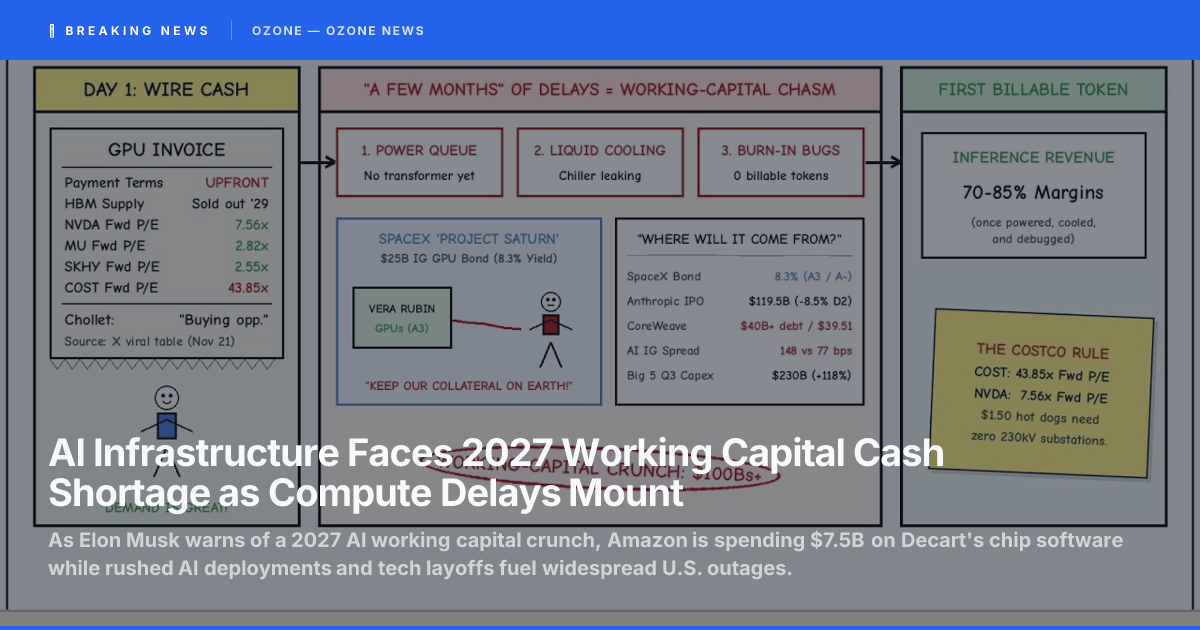
The artificial intelligence sector faces a projected working capital cash shortage in 2027 as physical delays in grid connections, cooling infrastructure, and data center buildouts lag behind massive upfront processor investments. The warning from Elon Musk arrives as Amazon spends $7.5 billion to acquire Decart's Trainium optimization technology and rushed AI deployments contribute to cascading U.S. infrastructure outages.
Key Takeaways
- 1Elon Musk warned on November 21, 2026, that cumulative data center and grid delays will create a massive AI cash shortage in 2027 requiring hundreds of billions in working capital
- 2Apollo Global Management and Goldman Sachs priced $44 billion in debt notes on November 20 to finance Nvidia Vera Rubin GPUs leased to SpaceX
- 3Amazon agreed to acquire the technology behind Israeli startup Decart for $7.5 billion to optimize its custom AWS Trainium chips and lower inference costs
- 4Cascading U.S. technology outages across airlines, financial networks, and federal systems coincided with the departure of White House Cyber Director Sean Cairncross
- 5Combined 2027 hyperscaler capital expenditures are projected to reach $1 trillion to $1.2 trillion, severely compressing industry free cash flows
SAN FRANCISCO, Beneath the record-breaking capital expenditures and multibillion-dollar hardware deals defining the artificial intelligence race, a stark liquidity warning is reverberating across Silicon Valley and Wall Street.
During a high-profile exchange on X with AI researcher François Chollet on November 21, 2026, Elon Musk warned that physical infrastructure delays could trigger a severe cash shortage across the AI sector in 2027.
The bottleneck is rooted in timing rather than customer demand. Companies are paying upfront for massive allocations of processors, land, and power equipment months, or years, before grid connections, cooling systems, and data center construction allow those clusters to generate commercial inference revenue.
"The cash shortage is also going to be nuts next year. Even cumulative industry delays of a few months between paying for compute and getting it reliable enough to generate revenue will mean hundreds of billions of incremental dollars just for working capital. Where will that come from?"
Elon Musk, Statement on XThe warning lands just days after Apollo Global Management and Goldman Sachs priced roughly $44 billion in debt notes on November 20 to finance Nvidia Vera Rubin GPUs leased to SpaceX, alongside SpaceX's broader $74 billion data center expansion plans in Texas and Arizona.
Across the broader hyperscaler landscape, including Amazon, Alphabet, Meta, Microsoft, and Oracle, consensus capital expenditure forecasts for 2027 have climbed toward $1 trillion to $1.2 trillion, threatening to push free cash flows near zero while debt markets demand stricter credit concessions.
Billions Deployed for Hardware
Hyperscalers and frontier AI labs pay upfront for processors, land, and power equipment years before activation.
Infrastructure Delays Mount
Interconnection queues, utility bottlenecks, and cooling installation delays push live compute dates back months.
Working Capital Gap Widens
Hundreds of billions in carrying costs and delayed revenue force debt market concessions as free cash flow tightens.
Amazon Strikes $7.5 Billion Deal for Decart Stack
To combat soaring compute costs and reduce reliance on third-party GPU supply chains, hyperscalers are aggressively acquiring software that squeezes maximum efficiency out of custom silicon.
On Monday, November 23, 2026, Amazon (NASDAQ: AMZN) officially announced an agreement to acquire the proprietary technology behind Israeli-founded startup Decart, specifically the Decart Optimization Stack (DOS), while bringing Decart's co-founders and engineering team into Amazon's fold.
According to Bloomberg, the transaction is valued at approximately $7.5 billion, roughly 1.9 times Decart's $4 billion valuation from May 2026.
| Deal Parameter | Official Terms & Operational Details |
|---|---|
Reported Deal Value | ~$7.5 Billion USD (~1.9x May 2026 valuation) |
Acquired Technology | Decart Optimization Stack (DOS) |
Primary Silicon Target | AWS Trainium AI Chips (alongside multi-chip support) |
Talent Integration | Decart co-founders & engineers join Amazon AI org |
Strategic Objective | Boost inference efficiency & cut AI compute costs |
Having collaborated closely with Amazon since 2025, Decart's software specializes in low-level kernel and system optimization that accelerates AI model training and inference on AWS Trainium chips. As Amazon prepares to commercialize Trainium hardware more broadly, owning DOS provides a critical software layer to lower per-token inference costs and improve margins amid tightening capital conditions.
Why did Amazon acquire Decart for $7.5 billion?
Amazon acquired Decart to integrate its Optimization Stack directly into AWS Trainium silicon, cutting inference costs and accelerating model execution to protect margins as hyperscaler infrastructure spending tightens.
Source: TechCrunch, November 2026
Operational Fallout | AI Patches, Layoffs, and Tech Outages
While tech giants pour capital into physical chips and optimization software, the human and operational cost of moving at breakneck AI speed is spilling into critical national infrastructure.
Over the past week, a cascading series of major U.S. technology outages disrupted airports, banking systems, cloud platforms, and even an internal National Security Agency (NSA) network, culminating in the abrupt ouster of White House National Cyber Director Sean Cairncross on November 19 to 20, 2026.
Cybersecurity experts and industry analysts point to a dangerous convergence behind the instability:
- AI-Accelerated Flaw Discovery & Rushed Patching: Automated AI security tools are uncovering software vulnerabilities faster than human engineering teams can safely test and deploy fixes, leading organizations to push rushed, AI-assisted patches directly into live production environments.
- Workforce Attrition & Institutional Knowledge Loss: Following waves of tech layoffs and massive voluntary buyout programs across major software vendors, leaner engineering teams are managing increasingly complex automated pipelines with fewer senior site-reliability engineers on watch.
- Fragility Over Malice: Although initial speculation pointed toward coordinated foreign cyberattacks, White House intelligence officials stated the disruptions were not malicious, underscoring that hurried AI integration and hollowed-out operational teams are creating systemic fragility from within.
What caused the recent wave of U.S. technology outages?
Federal intelligence officials confirmed disruptions were caused by internal fragility: automated AI tools discovering vulnerabilities faster than teams could vet them, combined with rushed automated patches and depleted engineering staffs after tech layoffs.
Taken together, the developments illustrate the dual reality of the late 2026 AI landscape: the technology's financial and physical demands are outpacing electrical grids and balance sheets, while the rush to automate software operations is testing the reliability of the digital infrastructure the economy depends on.
Frequently Asked Questions
Frequently Asked Questions
Sources
- ^[1]Crypto Briefing. Elon Musk Warns AI Industry Faces a Cash Crunch in 2027 (November 2026)
- ^[2]MLQ.ai. Musk Warns AI's Cash Shortage Will Be 'Nuts' Next Year as Data Center Delays Tie Up Working Capital (November 2026)
- ^[3]About Amazon. Amazon to Purchase Decart's AI Optimization Technology (November 2026)
- ^[4]TechCrunch. Amazon Snaps Up Decart's AI Optimization Tech for $7.5B as It Prepares to Sell Trainium Chips (November 2026)
- ^[5]Cybersecurity Dive. National Cyber Director Sean Cairncross Leaving the Government (November 2026)