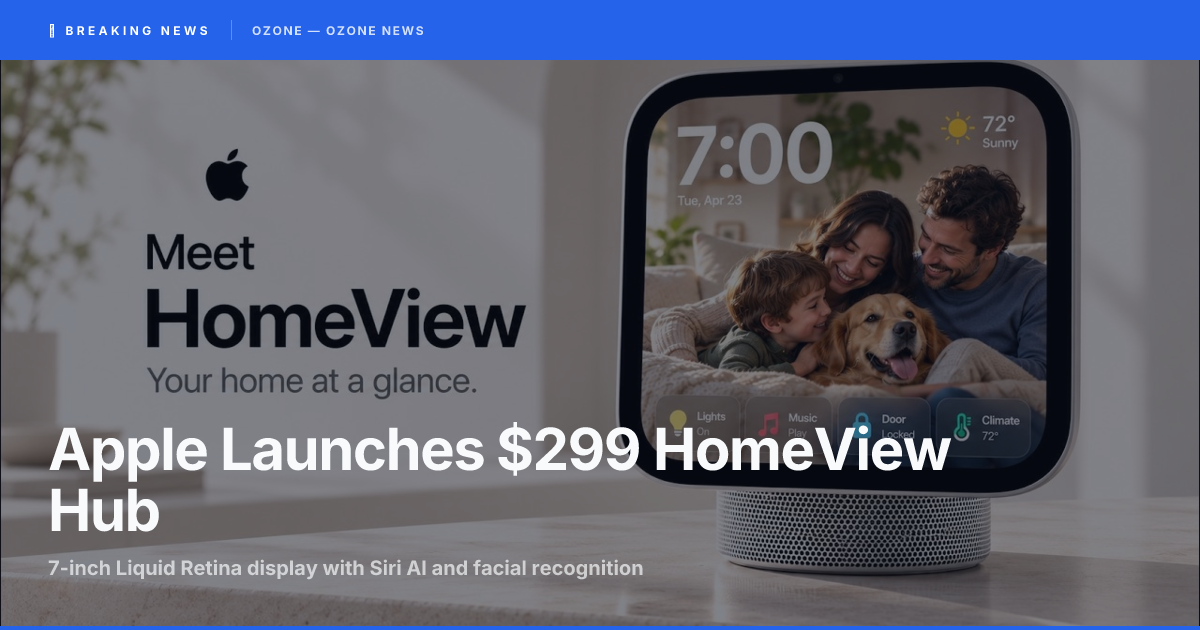
Ending years of speculation regarding its next major hardware category, Apple officially pulled back the curtain on HomeView during its targeted Welcome Home press showcase on Tuesday, October 13, 2026. Priced at $299, the device represents Apple's first dedicated standalone smart home display, designed to act as a centralized, privacy-first command center for households.
Positioned to challenge established competitors like the Amazon Echo Show and Google Nest Hub, HomeView blends classic Apple industrial design with localized Siri AI powered by Apple Intelligence. Pre-orders opened immediately on October 13, with official retail shipments set to begin Friday, November 13, 2026.
Retro design and adaptive display engineering
Taking heavy inspiration from the iconic 2002 iMac G4, the tabletop edition of HomeView pairs a 7-inch Liquid Retina display with a stainless steel hinge mounted on a weighted, domed speaker base. The swiveling arm lets users tilt the screen for comfortable viewing across countertop, nightstand, or desk heights.
Apple built adaptive screen technology into the panel to keep it livable in shared residential spaces. True Tone with ambient dimming shifts color temperature through the day, scaling from a vivid 500 nits in sunlit kitchens down to an ultra-dim 0.3 nits on a bedroom nightstand. A distance-aware interface uses internal optical sensors to scale the UI, showing simplified glanceable clocks, weather, and camera badges when viewed across a room, then expanding into detailed widgets, personal calendars, and HomeKit controls as a user steps closer.
Alongside the $299 tabletop version in Space Gray, Silver, Starlight, and Rose Pink, Apple also debuted a wall-mountable edition in Space Gray and Silver aimed at entryways and hallways.
Facial recognition and multi-user privacy
A core challenge of shared household displays is balancing communal utility with personal data privacy. HomeView addresses it through on-device facial recognition. When a registered household member approaches, the device scans locally, then transitions from a communal dashboard showing shared photo albums, climate controls, or door locks to that person's personalized home screen.
The system recognizes up to six individual family members. Private iMessages, personal calendar reminders, and individual Apple Music playlists remain hidden until the designated user is identified. That local-first approach is consistent with how Apple has handled privacy disputes elsewhere, including its recent clash with UK authorities over data protection, where the company kept processing inside the device rather than building server-side access.
It also mirrors the privacy posture Apple has applied to its camera-equipped smart glasses program, where on-device processing is the answer to the awkwardness of a wearable camera in shared spaces. A camera on the kitchen counter raises the same objection, and HomeView's answer is the same: recognize locally, store nothing off-device.
Siri AI core and the wider October 13 lineup
Under the hood, HomeView functions as a physical anchor for Siri AI. Using spatial audio microphones and localized Apple Silicon processing, Siri handles complex multi-turn conversational queries, draws context from connected iPhones, and executes broad HomeKit and Matter automations without sending raw audio feeds to external servers.
The hub debuted alongside three other announcements. An upgraded HomePod mini 2 brings S10 silicon and fresh color options. A refreshed Apple TV 4K runs on the A19 chip with hands-free Siri AI controls. And the Apple Home Collection introduces native smart locks, video doorbells, and floodlight cameras developed in partnership with LG and Schneider Electric.
That accessory push matters because the entry price is what makes it a system rather than a single gadget. Apple already leans on financing to lower hardware barriers through its Klarna device leasing program, and a $299 hub sits comfortably inside that kind of monthly structure compared to the $1,999 iPhone Duo Apple unveiled earlier this fall.
HomeView against the agentic field
The competitive frame is no longer just Echo Show versus Nest Hub. Voice assistants are being replaced by agents that act, and HomeView is Apple's attempt to own the physical surface where those agents live in the home.
Meta is attacking the same layer from the consumer side. Meta Muse reached 5 million downloads in 22 days by pushing an agent through WhatsApp, Instagram, and Ray-Ban glasses rather than a dedicated hub, and its audio-first glasses add hands-free access that competes for the same glance-free interaction HomeView is designed around.
OpenAI is going the other way, toward persistent background workers. OpenAI Dots run always-on agents on dedicated cloud virtual machines, the architectural opposite of HomeView local processing. Apple's bet is that households will trade some capability for a device that never ships their kitchen conversations to a third-party server.