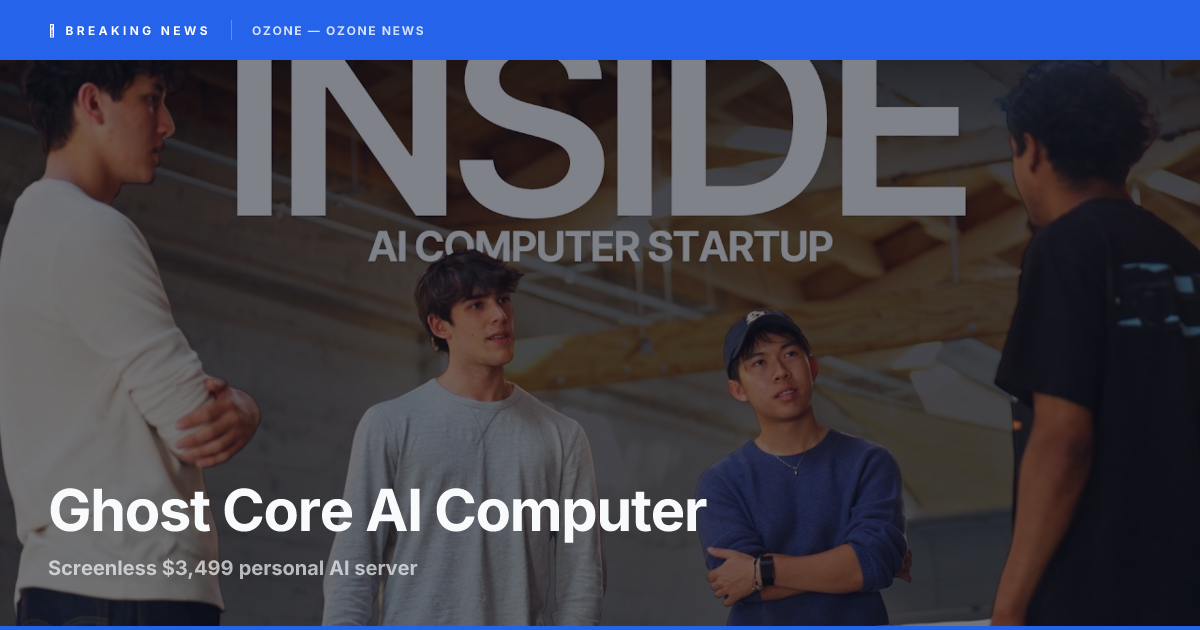
As big tech giants race to centralize agentic AI inside multi-billion-dollar cloud data centers, a growing subset of developers and privacy-conscious users is pushing in the opposite direction: local, sovereign, on-device compute. Challenging the cloud-first status quo, San Francisco-based hardware startup Ghost has officially emerged from stealth, announcing an $11 million seed funding round led by venture capital firm Andreessen Horowitz (a16z), with participation from Abstract, Audacious Ventures, SV Angel, and Nova.
Founded by 19-year-old entrepreneur Zain Javaid, Ghost is launching its inaugural flagship product: Core, a $3,499 screenless personal computer purpose-built from the chassis up to run autonomous personal AI agents entirely on local hardware.
What is Core | The screenless brain in a box
Unlike traditional desktop PCs or laptops, Core features no physical display outputs or screen interfaces. Instead, the device functions as a whisper-quiet, in-home local AI node, a dedicated brain in a box designed to sit on a desk or bookshelf while constantly executing tasks in the background.
Users interact with Core primarily through a companion mobile application. From there, users can assign complex, long-horizon workflows, such as analyzing personal financial records, organizing local documents, or orchestrating web automations, without transmitting sensitive personal telemetry or private files to third-party cloud servers.
Powering the desktop node | On-device models and silicon
To enable multi-step agentic capabilities locally without relying on external API calls, Ghost engineered a custom thermal and silicon architecture tailored for high-density open-weights inference. Core is powered by an Nvidia RTX Pro 4000 SFF GPU built on Nvidia Blackwell architecture, providing the high unified memory bandwidth required to keep large open-source LLMs resident in local VRAM.
The device arrives pre-loaded with optimized quantized builds of open-weights models, including Qwen-3.8-27B and Gemma-4-31B, allowing the agent to perform continuous background reasoning without incurring per-token API subscription fees. Because all user credentials, files, and chat histories are stored locally inside the physical chassis, Core addresses growing consumer anxieties regarding data scraping and model training on private files.
The local-first approach mirrors the broader shift toward persistent AI agents seen across the industry, but Ghost is betting that privacy-conscious users will pay a premium for hardware that keeps their data at home rather than renting intelligence from a cloud provider.
Manufacturing and pre-order horizon
With assembly taking place at a dedicated manufacturing facility in San Francisco, pre-orders for the $3,499 Core unit opened this week, with the first production run scheduled to ship to early adopters during the final week of October 2026.
While the $3,499 price tag positions Core as a high-end hardware investment compared to monthly cloud subscriptions, Ghost successful $11 million seed raise proves that venture investors see significant commercial appetite for sovereign, privacy-first local AI infrastructure. The device competes in a growing category that includes cloud-based agent platforms like OpenAI Dots, but from the opposite end of the compute spectrum.
The screenless form factor also signals a bet on ambient computing, where the machine disappears into the room and the mobile phone becomes the primary interface. That design philosophy aligns with the hardware experimentation happening across the industry, from foldables to dedicated AI appliances. It also echoes the attention battles playing out in the agentic AI market, where startups are fighting for mindshare against cloud incumbents.