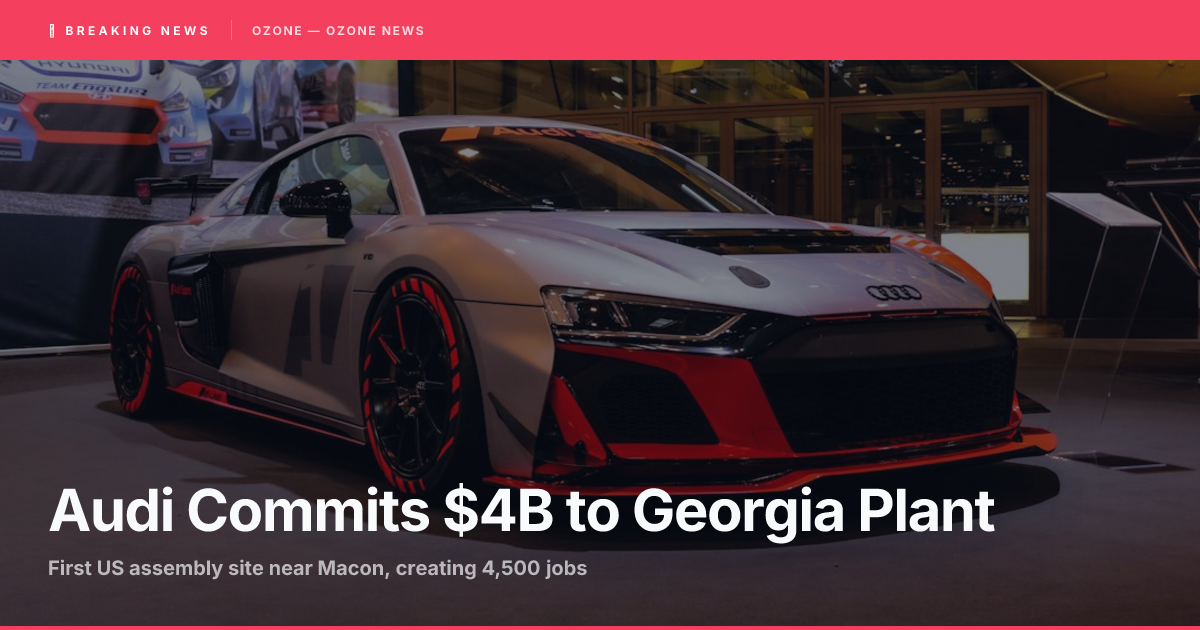
In a landmark strategic expansion for European automotive manufacturing in North America, German luxury brand Audi AG has officially announced plans to construct its first-ever assembly facility in the United States. The subsidiary of Volkswagen Group intends to invest approximately $4 billion, up to $4.2 billion across initial infrastructure phases, to build a state-of-the-art plant at the Middle Georgia Megasite near Macon, Georgia.
The announcement was made alongside President Donald Trump during a campaign event in Perry, Georgia on Saturday, October 24, 2026. Designed to establish North America as a core pillar of Audi's global manufacturing network alongside Europe and China, the project is expected to generate roughly 4,500 direct manufacturing jobs and achieve an annual production capacity of 200,000 vehicles once fully operational.
What the factory will build | Heavy luxury SUV focus
Groundbreaking at the Middle Georgia site is slated to begin next year, with full-scale vehicle assembly planned for the early 2030s. The plant will be engineered specifically to produce Audi's largest, high-margin passenger vehicles tailored to North American consumer preferences.
Assembly plans center on the premium full-size crossover SUVs sold in the US market, including the Audi Q7, Q8, and the newly announced three-row Q9 flagship. Building the facility from the ground up lets Audi integrate sustainable paint processes, a localized regional parts-supplier network across the American Southeast, and modern assembly robotics in one footprint.
The localization matters because Audi currently imports every US-market passenger car and crossover from production lines in Germany, Slovakia, and Mexico. Owning a Georgia plant removes transatlantic logistics delays, stabilizes inventory, and shortens dealer lead times on the segments where US buyers spend the most.
Tariffs and the $1.4 billion hit | Why Georgia now
While the $4 billion investment hands Georgia state officials a major economic victory, it comes during a delicate financial balancing act for parent company Volkswagen Group. Surging trade tariffs on imported European automobiles dealt Audi an estimated $1.4 billion (1.2 billion euros) financial hit over the past year. Local assembly in Georgia secures long-term tariff relief on the highest-earning vehicle segments Audi sells in the United States.
The US tax and regulatory environment has also been pulling toward domestic production. That direction fits the broader capital wave into American industrial capacity, from the $40 billion Nvidia GPU procurement SpaceX is financing to the robotaxi manufacturing push Tesla is scaling under federal scrutiny. Audi is joining that pattern with a slower, more traditional kind of industrial commitment.
European restructuring and the political stage
The announcement has raised eyebrows in Europe, where Volkswagen Group is navigating steep cost-reduction measures and potential factory closures across Germany. Responding to criticism over a multi-billion-dollar overseas outlay during domestic restructuring, Audi CEO Gernot Doellner defended the decision as essential for long-term corporate survival.
The United States is one of the world's most important premium markets, and Audi has not yet realized its full potential there, Doellner said in announcing the plant. He framed the factory as a long-term investment rooted in belief in the American market, arguing that Audi's future will not be secured by cost reductions alone and that the company needs the courage to invest in new opportunities.
The political framing is unmistakable. The plant was revealed at a Trump campaign event, and the announcement leans on the tariff and industrial policy instincts that have defined the Trump economic agenda. For Georgia, the win is concrete: a megasite that had been marketed for years finally lands an anchor tenant, and the Peach State adds another signature automotive project to its manufacturing resume.
The economic-security angle is visible in the supply chain logic too. As US agencies have spent the year hardening critical infrastructure against external threats, automakers have pursued the same localization argument in commercial terms, building redundancy closer to the point of sale rather than relying on distant plants.
Georgia and the Southeast auto hub
By placing its manufacturing footprint inside the American Sun Belt, Audi joins fellow German luxury rivals BMW in Spartanburg, South Carolina and Mercedes-Benz in Vance, Alabama, turning the Southeast into an international automotive manufacturing hub. The Middle Georgia Megasite sits in Peach County, giving the plant rail and interstate access that suits both domestic distribution and potential export routes.
Georgia Governor Brian Kemp framed the selection as the largest single capital commitment in state history, and local officials expect the supplier network to multiply the 4,500 direct jobs several times over once parts plants cluster around the campus. For Audi, the calculus is simpler: a plant in the same time zones as its biggest export market, minus the tariff, with the Q9 flagship arriving just as the line comes up to speed.